
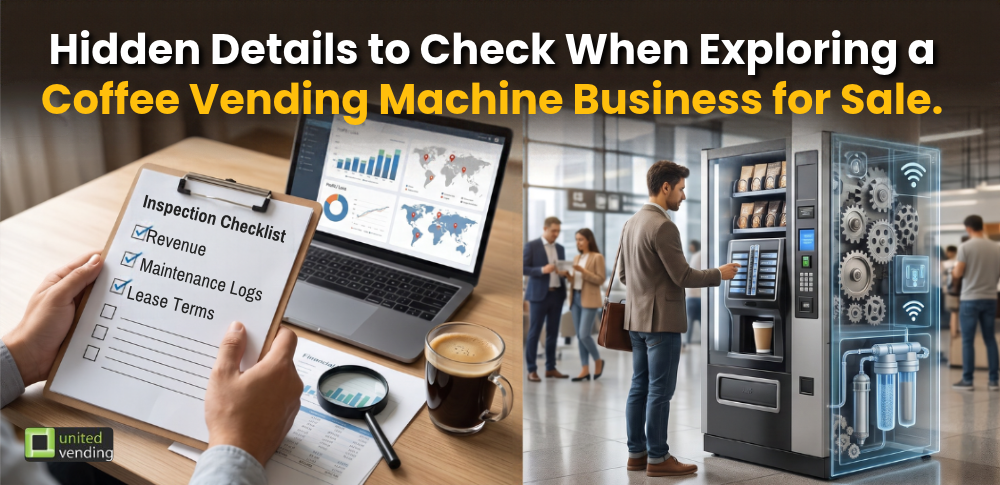
If you’re looking at a coffee vending machine business for sale, the headline numbers rarely tell the full story. Location quality, machine condition, supplier agreements, and actual footfall data matter far more than what’s written on a listing. Before you commit to anything, here’s what deserves a closer look, and what sellers often don’t volunteer upfront.
Why Due Diligence on a Vending Business Is Different
Buying any business requires scrutiny. But a coffee vending machine business for sale has a few quirks that make standard due diligence slightly inadequate on its own.
The revenue is tied almost entirely to physical locations and machine reliability. If the machines are aging, the locations are weak, or the contracts with site owners are shaky, the income dries up fast, and you’ve inherited someone else’s problem. Unlike a retail shop or a service business, there’s no brand equity or customer loyalty to fall back on. It’s the machine, the location, and the product. That’s it.
So the questions you ask need to go deeper than “how much does it make per month?”
Start With the Machines Themselves
Age and Service History
This is the first thing to establish. A coffee vending machine that’s five years old and well-maintained is a very different proposition from one that’s the same age but has had irregular servicing. Ask for a full service history on every machine in the portfolio.
Look out for machines that have had repeated faults with the same component, a grinder that keeps failing, a payment system that’s been patched rather than replaced. These are signs of deferred maintenance that you’ll end up paying to fix shortly after purchase.
Compatibility With Supplies
Some machines are locked to a specific supplier for beans, cups, or cleaning products. That’s worth understanding before you buy, because it limits your flexibility on margins and means you’re inheriting someone else’s supplier relationship, including whatever pricing they negotiated, or failed to.
If the machine takes standard commercial supplies available from multiple sources, you have more room to negotiate once it’s yours.
The Locations Are the Real Asset
How Secure Are the Site Agreements?
In a coffee vending machine business for sale, the machines are almost secondary to where they’re placed. A machine in a busy London office building or a high-footfall leisure centre is worth significantly more than the same machine in a low-traffic location.
What you need to know is whether those locations are secured by a formal agreement or just a handshake arrangement with the site owner. Informal agreements are common in vending, and they can evaporate quickly when the site owner decides to switch suppliers, refurbish the space, or simply change their mind.
Ask for copies of all site agreements. Check the notice periods. A portfolio where every location can walk away with thirty days’ notice is a riskier investment than one with twelve-month rolling contracts.
Footfall Data and Actual Sales Per Machine
Sellers will often give you an overall revenue figure. What you want is a breakdown by machine and by location. Some sites will be carrying others, one machine in a great spot generating most of the income whilst three others barely cover their costs.
That granularity changes the valuation considerably. If the best-performing machine is in a location whose lease is up for renewal in six months, that’s a material risk the top-line number doesn’t reflect.
Supplier and Restocking Arrangements
Who Currently Handles Restocking?
If the current owner is running the restocking themselves, you need to factor in whether you have the time and resource to do the same, or the cost of outsourcing it. If they use a third-party restocking service, check the terms of that arrangement and whether it transfers with the business.
For businesses considering a free on-loan vending model rather than outright purchase, this operational overhead disappears entirely — but that’s a separate conversation for a different kind of setup.
Product Margins
Coffee vending margins vary significantly depending on the beans, the cup cost, the machine’s brew yield, and what price point the site supports. A machine in a London financial services office can charge more per cup than one in a warehouse canteen. Neither is wrong — but the margin profile is different, and you need to understand it before assuming the revenue translates cleanly into profit.
Regulatory and Compliance Checks
This is an area that gets overlooked more often than it should. Commercial coffee vending machines that handle food and drink are subject to food hygiene standards. Check that the machines have been cleaned and serviced to the required schedule and that there’s a paper trail to prove it.
If any of the machines are placed in regulated environments: healthcare settings, schools, or similar, there may be additional compliance requirements that need to be met and documented. Find out before you buy, not after.
What the Seller Isn’t Telling You
This sounds harsh, but it’s practical. Most sellers of a coffee vending machine business for sale aren’t being deliberately deceptive, they’re just presenting things in the best light, as anyone would. Your job is to find the gaps.
A few questions worth asking directly:
- Why are you selling now? (Timing matters. A seller exiting because a major site is closing is different from one retiring after a successful run.)
- Have you lost any locations in the last twelve months?
- Are there any machines currently out of service?
- Have there been any complaints from site owners in the past year?
The answers won’t always be volunteered. But asking them directly tends to surface things that wouldn’t otherwise come up.
Is It Worth the Complexity?
There’s a reason the coffee vending machine business for sale market attracts buyers; it’s a relatively low-overhead, recurring-revenue model that doesn’t require premises or a large team. Done well, it works.
But the hidden details outlined above are real, and they can turn a seemingly straightforward acquisition into a costly one. The businesses that hold their value are the ones with strong locations, well-maintained machines, and actual site agreements that give you something to stand on.
If you’re exploring the vending space more broadly and wondering whether ownership is the right route, it’s worth understanding what a managed vending partnership looks like as an alternative. United Vending works with London businesses to place and manage machines with no upfront cost and no contracts, a model that removes much of the operational complexity that makes outright ownership demanding. Get in touch to find out how it works.
FAQs
- What should I look for when buying a coffee vending machine business for sale?
Focus on machine condition and service history, the security of site agreements, actual revenue per location, supplier arrangements, and any compliance documentation. The headline revenue figure rarely tells the full story. - Are site agreements transferable when buying a vending business?
Not automatically. Some site owners will need to agree to a transfer, and informal arrangements may not carry over at all. Always review every location agreement before completing a purchase. - How do I value a coffee vending machine business?
Valuation typically applies a multiple to net profit, but the quality of locations and the length of site agreements significantly affect what that multiple should be. A portfolio with insecure locations is worth less, regardless of current turnover. - What are the ongoing costs of running a coffee vending business?
Restocking, machine servicing and repairs, site commissions (if applicable), consumables, and insurance are the main ongoing costs. Labour for restocking is often the largest variable depending on how the business is structured. - Is buying a coffee vending machine business a good investment in London?
It can be, given London’s density of workplaces and consistent demand. The key is location quality, a well-placed machine in a high-footfall London site will consistently outperform one in a quieter location, so due diligence on where the machines sit matters enormously.